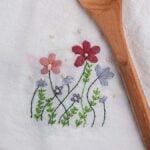
DIY Embroidered Flour Sack Towels
Learn how to create beautiful DIY embroidered flour sack towels for your kitchen or for gifts. This craft project is fun and simple.
Equipment
- Embroidery Hoop 8-Inch
Instructions
Step 1:
- Print the embroidery pattern, and place it on the underside of the flour sack towel where you want the embroidery to be placed. You will be able to faintly see the pattern through the towel.
- Trace the pattern with a light pen or water soluble marker. To make this easier, you can tape the pattern to a window, and trace to see it easier.
Step 2:
- Center the traced design on the embroidery hoop with the bamboo ring on the back of the towel.
- Place the adjustable hoop on top of the towel and gently stretch the material taut before screwing the hoop shut.
Step 3 (dark green stems):
- For the dark green stems, cut about three feet of embroidery floss. There will be six individual strands. Gently pull apart the floss so you have 2 or 3 strands to work with. (This makes the floss thinner so it will lay better once the project is complete).
- Tie a double knot at the end of your working string, and thread the other end through a needle with a few inches of excess to keep the string from falling out of the needle.
- Pull the needle up through the back of the fabric making sure that it comes out at the bottom of the traced line on the front. Pull the floss through the fabric until it stops from the knot tied in the back.
- Push the needle through the front of the fabric about 1 mm above the last hole, and pull the string all the way through to complete the stitch.
- Next, pull the string through the back of the fabric about 1 mm above the completed stitch. Push the string back through the same hole that completed the last stitch. Repeat step 3b–c for the remainder of the stem.
Step 4:
- Repeat step 3 for all other dark green stems in the project.
Step 5 (light green stems with leaves):
- For the light green stems, you will repeat step 3 using the light green embroidery floss.
- When that is complete, you will move on to the leaves.
- Continuing on with the working string that is still attached from the stem, pull the string through the base of the top right leaf from the back of the fabric. Pull the string all the way through until it is taught at the back.
- From the front of the fabric, push the needle through the same hole that you just made. Push the yarn through until there is a small loop in the thread the size of the leaf leftover.
- Without pulling the string all the way through the fabric, pull the needle through the back at the high point of the leaf and through the loop of thread. Pull the string all the way through until taut.
- Push the needle through the same hole made previously at the highest point of the leaf, and pull the string all the way through. This will create a leaf on the side of the stem.
Step 6:
- Repeat step 5 for all other light green stems with leaves on the project.
Step 7 (3 large flowers):
- Repeat the first part of step 3 to attach the string to the project.
- Pull the needle through the back of the fabric at the highest point of either the leftmost or rightmost petal. Push the needle through the fabric at the point where all of the petals meet in the center, and pull the string taut.
- Repeat the above and follow the outline of the petals to know where the needle comes through the back of the fabric. Continue to push the needle through the center point where the petals meet to finish each stitch.
Step 8 (small flowers):
- Even though some of the smaller flowers are half flowers, the process for stitching them will be the same as the 5-petal small flowers.
- Repeat Step 2 to attach the string to the project.
- This stitch is called the “lazy daisy.” Pull the string through the back at the center point where all the petals meet, then push it back through the same hole.
- Pull the string through almost all the way, while leaving a small loop on the front of the project. Pull the string through the back of the fabric and through the loop. Pull the string taut.
- Push the string through the highest point of the petal and pull the string taut, this will create a petal.
- Repeat for the other petals in the flower.
Step 9 (flower centers and decorative dots):
- This stitch is called a “French knot,” and it will be used for all flower centers and decorative dots to finish up the project.
- Repeat Step 2 to attach the yarn to the project.
- Pull the yarn through the back of the fabric at the center of each flower, or the center of the traced dot.
- Wrap the string around the needle three times.
- While holding the working thread in one hand and the needle in the other, push the needle back through the same hole created in the center of each flower or dot.
- Pull the thread all the way through the back to make sure it is taut. This will create a small knot to finish off each flower center.
Finishing the Back:
- There are 3 options to finish the back of the project.
- If the towel used is light or decorative, you can leave the back unfinished as it will not be seen when the towel is hanging.
- (Preferred option) Cut a circle of fabric that will cover all of the loose ends and back of the project. Use an iron on adhesive sheet cut in the shape of the fabric to finish off the back. Iron this on the back as per the instructions on the iron on sheet.
- Cut a circle of scrap fabric that will cover all of the loose ends and use fabric glue to attach it to the back of the towel. Let the glue dry completely before folding the towel.
Notes
Get creative with colors: You can use any colors for this project, so feel free to get creative with different threads to make the flowers pop! If you want to recreate this version, I used colors 3722, 3801, 890, 414, 415, and ecru from this pack of embroidery floss.
Take your time: Be patient with yourself as you're stitching, taking your time to avoid having to take stitches out frequently.
Larger or smaller design: If you end up printing the design larger or smaller than the original, move the embroidery hoop around after completing each section in case there are any parts that are cut off in the original hoop position.
Take your time: Be patient with yourself as you're stitching, taking your time to avoid having to take stitches out frequently.
Larger or smaller design: If you end up printing the design larger or smaller than the original, move the embroidery hoop around after completing each section in case there are any parts that are cut off in the original hoop position.
QR code
Scan this QR code with your phone's camera to view this recipe on your mobile device.
